Fazaaile-Durood: Contents Page
CHAPTER FIVE: STORIES PERTAINING TO CONFERRING
BLESSINGS AND SALUTATIONS
After discussing the order of
Allāh to confer blessings and salutations
and the ḥadīths of the Noble Prophets e, stories are not of much
significance. However, people tend to be more encouraged by the stories of the
pious elders. Thus, it has also remained the practice of the elders to mention
relevant stories. Shaykh Thānawī (may Allāh have mercy on him) has dedicated a whole chapter
to stories in Zād al-Saʿīd, which I am relating exactly
in this book too. Thereafter, I shall narrate other stories, and many stories have been narrated in the Virtues of Ḥajj, authored by this humble servant.
1. It is narrated in al-Mawāhib
al-Ladunniyya from Tafsīr al-Qushayrī that on the Day of
Judgement, the good deeds of a certain believer will weigh less in the Scales.
The Messenger of Allāh e will take out
a parchment the size of a fingertip and place it in the pan of good deeds,
causing it to outweigh the bad deeds of this believer. The believer will
exclaim, “May my parents be sacrificed for your sake. Who are you? How
beautiful you are in countenance and in character!”
The Noble Prophet e will reply,
“I am your prophet and this is your conferring of blessings and salutations
upon me. I have repaid it in this time of need.”
(Footnotes of Al-Ḥiṣn al-ḥaṣīn. This story
has previously been mentioned with more discussion in Chapter One under the eleventh ḥadīth)
2. ʿUmar bin ʿAbdul ʿAzīz (may
Allāh have mercy on him) was a prominent Follower (tābiʿī) and a rightly-guided caliph. He would send a special messenger
from
3. It is related in Rawḍa al-Aḥbāb that
Imām Ismaʿīl bin Ibrāhīm Muzanī (may Allāh have mercy on him),
one of the prominent students of Imām Shafiʿī (may
Allāh have mercy on him) said, “I saw Imām Shafiʿī (may
Allāh have mercy on him) in my dream after he had passed away. I
asked him, ‘How did Allāh treat you?’
He replied, ‘Allāh pardoned me and ordered that I be taken to
I asked, ‘What was it?’
Imām Shafiʿī (may Allāh have mercy on him) said:
اللهُمَّ صَلِّ عَلَى مُحَمَّدٍ كُلَّمَا ذَكَرَهُ الذَّاكِرُوْنَ وَكُلَّمَا غَفَلَ عَنْ ذِكْرِهِ الْغَافِلُوْنَ
O Allāh, confer blessings upon Muḥammad e whenever those engaged
in his remembrance remember him and whenever those who are negligent of his
remembrance are in their neglect. (Footnotes of Al-Ḥiṣn
al-ḥaṣīn)
4. It is related in Manāhij al-Ḥasanāt from
Ibn Fākihāni’s (may
Allāh have mercy on him) Al-Fajr al-Munīr, “There was a
saint called Musā Ḍarīr (may
Allāh have mercy on him) who related his personal experience to me.
He said, ‘I was travelling in a boat which began to sink. Suddenly, I was overcome
by drowsiness and in this state, I saw the Messenger
of Allāh e. He taught me these blessings
and then instructed that all aboard the boat should confer them one thousand
times. We barely recited it three hundred times that the boat was saved from
sinking.’”
The ṣalāt is as follows:
اللهُمَّ صَلِّ عَلَى سَيِّدِنَا مُحَمَّدٍ صَلَوةً تُنْجِيْنَا بِهَا مِنْ جَمِيْعِ الأَهَوَالِ وَالآفَاتِ وَتَقْضِيْ لَنَا بِهَا جَمِيْعَ الْحَاجَاتِ وَتُطَهِّرُنَا بِهَا مِنْ جَمِيْعِ السَّيِّئَاتِ وَتَرْفَعُنَا بِهَا أَعْلَى الدَّرَجَاتِ وَتُبَلِّغُنَا بِهَا أَقْصَى الْغَايَاتِ مِنْ جَمِيْعِ الْخَيْرَاتِ فِيْ الْحَيَوةِ وَبَعْدَ الْمَمَاتِ
It is also desirable to add the following words at the end:
إِنَّكَ عَلَى كُلِّ شَيْءٍ قَدِيْرٌ
O Allāh, confer blessings upon our leader Muḥammad
e, blessings
whereby You will save us from all worries and calamities, whereby You will
fulfil all our needs, purify us from all sins, raise our ranks to the most
lofty of stations, convey us to the furthest heights in all acts of goodness in
this life and the Hereafter. (Verily you have power over everything).
The author of Al-Qāmūs, Shaykh Majduddīn (may Allāh have mercy on him),
has also narrated this story through his own chain of narration.
5. It is related in some books that ʿUbaydullāh
bin ʿUmar Qawārīrī (may Allāh have mercy on him)
said, “A neighbour of mine, who was a scribe, passed away. I saw him in a dream
and asked him how Allāh had treated him. He told me that Allāh had
pardoned him. I asked him the reason thereto. He said, ‘It was my habit that
whenever I wrote the blessed name of the Messenger of Allāh e, I would add (e). Allāh
granted me bounties that no eye has ever seen, no ear has ever heard and the
thought of which has never crossed the mind of any person.’” (Gulshane Jannat)
6. The incident which inspired the author of Dalā’il
al-Khayrāt to write his book is famous. The author was in need of
water for ablution whilst traveling but was perturbed
as he had no rope or bucket [to draw water with from the well]. A girl who was
observing all this came and inquired of the Shaykh and then spat in the well.
As a result, the water brimmed to the top of the well. The author was shocked
upon seeing this and asked how she had done this. The girl replied that this
was the blessing of conferring blessings and salutations. The Shaykh then compiled Dalā’il
al-Khayrāt.
7. Shaykh Zarrūq (may
Allāh have mercy on him) writes that the grave of the author of Dalā’il al-Khayrāt emanates with the
fragrance of amber and musk and this is all due to the conferring of blessings
and salutations.
8. A reliable friend of mine informed me regarding a scribe of
9. The son-in-law of Mawlānā Fayḍ al-Ḥasan
Saharanpuri (may Allāh have mercy
on him) narrated to me that the house wherein the respected
Mawlānā passed away emanated with fragrance for one month after his
demise. This was related to Mawlānā Qāsim Nānawtwī (may Allāh have mercy on him) who
said, “This is due to the blessings of conferring blessings and salutations. The Mawlānā
would stay awake on the night of Friday and confer blessings and salutations
upon the Noble Prophet e.”
10. Abū Zurʿa (may
Allāh have mercy on him) saw a person in his dream who was
performing prayer with the angels in the heavens. He asked him how he achieved
this status. He replied, “I have written one million ḥadīths.
Whenever I came across the blessed name of the Prophet e, I would write blessings.
I achieved this status through this action.”
This
story has been narrated likewise in Zād
al-Saʿīd. This humble servant thinks that the scribe has made a
mistake in writing this story and that the correct account is that a person saw
Abū Zurʿa (may Allāh
have mercy on him) in a dream, as will be mentioned in story
twenty-nine.
11. Another
story regarding Imām Shafiʿī (may Allāh have mercy on him) is that someone saw him in a
dream after his demise and asked him how he was forgiven. Imām Shafiʿī
(may Allāh have mercy on him)
replied, “I used to confer the following five blessings on the night of Friday:
اللهُمَّ صَلِّ
عَلَى مُحَمَّدٍ بِعَدَدِ مَنْ
صَلَّى عَلَيْهِ وَصَلِّ عَلَى
مُحَمَّدٍ بِعَدَدِ مَنْ
لَمْ يُصَلِّ عَلَيْهِ وَصَلِّ عَلَى
مُحَمَّدٍ كَمَا
أَمَرْتَ بِالصَّلَوةِ عَلَيْهِ وَصَلِّ عَلَى
مُحَمَّدٍ كَمَا
تُحِبُّ أَنْ
يُّصَلَّى عَلَيْهِ وَصَلِّ عَلَى
مُحَمَّدٍ كَمَا
يَنْبَغِيْ أَنْ
يُّصَلَّى عَلَيْهِ
O Allāh, confer blessings upon Muḥammad e as the number of people who confer blessings upon him. Confer
as many blessings upon Muḥammad e as the number of people
who fail to confer blessings upon him. Confer blessings upon Muḥammad
e as You
have ordained that blessings should be conferred upon him. Confer blessings
upon Muḥammad as You like that blessings should
be conferred upon him. Confer blessings upon him as is the
right of blessings to be conferred upon him.
These are referred to as the Five
Blessings (al-ṣalawāt al-khamsa).
(Other stories regarding Imām Shafiʿī
(may Allāh have mercy on him)
will be discussed under the thirtieth story).
12. Shaykh Ibn Ḥajar Makkī (may Allāh have mercy on him)
narrates that a person saw a righteous man in his dream and asked him how he was.
He said, “Allāh had mercy on me, forgave me and entered me into
13. Shaykh Ibn Ḥajar Makkī (may Allāh have mercy on him) has
written that a certain righteous person had made a habit of conferring a fixed
number of blessings at bedtime. He saw in a dream one night that the Messenger
of Allāh e came to his house, causing
the whole house to become illuminated. The Noble Prophet e said, “Bring forward that mouth which confers blessings and
salutations upon me, so that I may kiss it.” Overcome with shyness he put his
cheek forward. The Noble Prophet e kissed his
cheek. He then awoke to find that his house was filled
with the fragrance of musk. (This story will be mentioned
with more detail under the thirty-eighth story).
14. Shaykh ʿAbdul
Ḥaqq Muḥaddith Dihlawī (may
Allāh have mercy on him) has written in Madārij al-Nubuwwa
that when Sayyidatunā Ḥawwā was created, Sayyidunā Ādam u moved towards
her. The angels said, “Be patient until you are married and paid the dowry.”
He asked, “What is the dowry?”
The angels replied, “To confer blessings and salutations upon the Noble
Prophet e three times.” In another
narration, twenty times is mentioned.
These stories are narrated in Zād al-Saʿīd. Other
scholars have been narrated some of these stories too. Besides these, the
scholars have written many incidents and dreams regarding this topic. A number
of them are being narrated in this book in addition to
the stories mentioned in Zād al-Saʿīd.
يَا
رَبِّ صَلِّ
وَ سَلِّمْ
دَائِماً
أَبـَدًا عَلَى
حَبِيْبِكَ
خَيـْرِ
الْخَلْقِ
كُلِّهِمِ
15. ʿAllāma Sakhāwī
(may Allāh have mercy on him)
writes on the authority of Rashid ʿAṭṭar who said, “There lived in
يَا
رَبِّ صَلِّ
وَ سَلِّمْ
دَائِماً
أَبـَدًا عَلَى
حَبِيْبِكَ
خَيـْرِ
الْخَلْقِ
كُلِّهِمِ
16. When Abū ʿAbbās
Aḥmad bin Manṣūr (may
Allāh have mercy on him) passed away, one of the residents of
Shiraz saw in a dream that he was standing in the niche (miḥrāb)
of the main mosque of the city, wearing a beautiful garment and a crown laden
with jewels and pearls. The person seeing the dream asked him about this. He
replied, “Allāh pardoned me and treated me with great dignity. He granted
me this crown. This was all in reward for conferring blessings and salutations
upon the Noble Prophet e abundantly.”
(Al-Qawl al-Badīʿ)
يَا
رَبِّ صَلِّ
وَ سَلِّمْ
دَائِماً
أَبـَدًا عَلَى
حَبِيْبِكَ
خَيـْرِ
الْخَلْقِ
كُلِّهِمِ
17. A saint from amongst the ṣūfīs
says, “In my dream, I saw a man named Misṭaḥ who had passed away
and who did not pay any attention to acting upon the Dīn i.e. he was a
very sinful person. I asked him, ‘How did Allāh treat you?’
He said, ‘Allāh pardoned me.’
I asked, ‘Upon which action?’
He said, ‘I was narrating ḥadīths in the presence of a ḥadīth
scholar (muḥaddith), who conferred blessings and thus I too conferred
blessings very loudly. On hearing me, everyone present in the gathering also
conferred blessings. Allāh forgave everyone present in the
gathering.’” (Al-Qawl al-Badīʿ)
A similar story in Nuzhat al-Majālis narrates from a
certain saint that, “I had a neighbour who was very sinful. I always pressed
upon him the need to repent but he would not listen. After he passed away, I
saw him in
This incident has been narrated in Rawḍ al-Fā’iq with more detail. It is
mentioned that a saint from the ṣūfīs said, “I
had a very sinful neighbour who always remained intoxicated from drinking and
could not even differentiate between day and night. I would counsel him but he
would not take heed, and I would ask him to repent but he would not listen. After
his demise, I saw him in a dream in an exalted position in
يَا
رَبِّ صَلِّ
وَ سَلِّمْ
دَائِماً
أَبـَدًا عَلَى
حَبِيْبِكَ
خَيـْرِ
الْخَلْقِ
كُلِّهِمِ
18. Abū ’l-Ḥasan Baghdādī
Dāramī (may Allāh have
mercy on him) says, “I saw Abū ʿAbdullāh bin Ḥāmid
(may Allāh have mercy on him)
many times in my dreams after he had passed away. I asked, ‘What happened to
you in the Hereafter?’
He replied, ‘Allāh pardoned me and had mercy on me.’
I asked, ‘Inform me of an action whereby I can gain direct entry
into
He said, ‘Perform one thousand rakʿāts of prayer,
reciting Surah Ikhlāṣ a thousand times in each rakʿāt.’
I said, ‘This is a difficult task.’
He said, ‘Then confer blessings a
thousand times every night.’ I thus made it my daily practice.” (Al-Qawl al-Badīʿ)
يَا
رَبِّ صَلِّ
وَ سَلِّمْ
دَائِماً
أَبـَدًا عَلَى
حَبِيْبِكَ
خَيـْرِ
الْخَلْقِ
كُلِّهِمِ
19. A person once saw Abū Ḥafṣ
Kāghidhī (may Allāh
have mercy on him) in a dream after his demise. He asked him, “What
happened to you?”
Abū Ḥafṣ (may
Allāh have mercy on him) said, “Allāh had mercy on me and
pardoned me. He ordered that I be entered into
This person then asked, “How did this happen?”
Abū Ḥafṣ (may
Allāh have mercy on him) replied, “When I was presented before
Allāh, the angels were ordered to count the blessings I had conferred and to
count my sins. The number of blessings I had conferred outnumbered my sins, so my
Lord said, ‘O angels, stop! Do not continue with his reckoning. Take him to my
يَا
رَبِّ صَلِّ
وَ سَلِّمْ
دَائِماً
أَبـَدًا عَلَى
حَبِيْبِكَ
خَيـْرِ
الْخَلْقِ
كُلِّهِمِ
20. ʿAllāma Sakhāwī
(may Allāh have mercy on him)
narrates from some books of history that there lived a very sinful person from
the Banū Isrā’īl. When he passed away, people
left him at the place of his death without tending to his burial. Allāh
sent revelation to Sayyidunā Mūsā u to bathe him and perform his funeral prayer, as He had forgiven
this person. Sayyidunā Mūsā u asked, “How was this person forgiven?”
Allāh Most High said, “He once opened the Torah and saw the
name Muḥammad e therein. He conferred
blessings upon reading his name and thus I forgave him.” (Al-Qawl al-Badīʿ)
There is no
point of objection in these stories. Neither do these stories mean that by conferring
blessings upon the Noble Prophet e once, all
major sins and the rights of servants (ḥuqūq al-ʿibād)
are forgiven nor do they contain any exaggeration or
falsehood. It all depends on the Master accepting an action. If He decides to
accept even the minutest of a person’s deeds such as the saying of the kalima
once (as in ḥadīth eleven of Chapter One)
it is sufficient for all sins to be pardoned.
Allāh
says in the Qur’ān:
إِنَّ اللهَ لاَ يَغْفِرُ أَنْ يُّشْرَكَ بِهِ وَيَغْفِرُ مَا دُوْنَ ذَلِكَ لِمَنْ يَشَاءُ
Surely
Allah will not forgive that anyone be joined with Him, and He will forgive all
else to whom He will (al-Nisā
4:48)
For this
reason, there is no doubt in this story and others of a similar nature as to
how Allāh can pardon all sins if He is pleased by the mere conferring of blessings
once, as He has absolute power. If a person is owed
thousands of pounds and he becomes pleased with an action of the recipient and thus
decides to absolve the debt, or he does even without any reason, what objection
can anybody else have? Likewise, if Allāh out of His
infinite grace and mercy wants to pardon someone, what objection can there
possibly be?
We certainly understand
from these incidents that conferring blessings is instrumental in the pleasure of
the Sovereign. Thus, confer blessings abundantly. Who knows which ṣalāt
of his He becomes pleased with? If He becomes pleased
with even one, it is enough for one’s salvation.
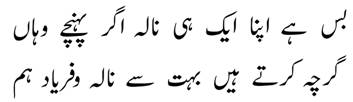
Even
one of our pleas is enough if it is accepted by Him,
Although we may plea and call out to Him in abundance.
يَا
رَبِّ صَلِّ
وَ سَلِّمْ
دَائِماً
أَبـَدًا عَلَى
حَبِيْبِكَ
خَيـْرِ
الْخَلْقِ
كُلِّهِمِ
21. A saint once saw a very disfigured and ugly
form in his dream. He asked, “Who are you?”
It replied, “I am your evil deeds.”
The saint asked, “How can I remain safe from you?”
It replied, “Confer blessings and salutations abundantly upon Muḥammad
the Chosen One e.” (Al-Qawl al-Badīʿ)
Who is there amongst
us who is not involved in sins day and night? Conferring blessings and
salutations is the best means of atonement. One should confer blessings upon
him as much as possible at all times and not lag behind for this is the greatest
antidote.
يَا
رَبِّ صَلِّ
وَ سَلِّمْ
دَائِماً
أَبـَدًا عَلَى
حَبِيْبِكَ
خَيـْرِ
الْخَلْقِ
كُلِّهِمِ
22. The Shaykh of all shakyhs Shiblī (may Allāh have mercy on him)
says, “A neighbour of mine passed away. I saw him in a dream and asked, ‘What
happened to you?’
He replied, ‘I faced severe difficulties and I was about to falter
at the time of questioning in the grave. At that time, I thought to myself, ‘O
Allāh, where have these hardships come from? Did I not die in the state of
Islām?’
I heard a voice from the unseen saying, ‘This is the punishment
for your carelessness in speech.’ When the two angels intended to inflict
punishment on me, an extremely handsome person appeared and got in the way of
the angels. His body was emanating with the best of fragrances. He told me what
answer to give to the angels and I was thus able to answer their questions
instantly. I asked this person, ‘May Allāh have mercy on you. Who are
you?’
He replied, ‘I have been created from your abundance of conferring
blessings. I have been ordered to help you in the face of every
difficulty.’”
Good deeds and
bad deeds will have their respective forms in the Hereafter. In
the second part of Virtues of Charity, it is mentioned under the
conditions faced after death that when the corpse is placed in the grave, prayer
stands to the right, fasting to the left, the remembrance of Allāh and the
recitation of the Qur’ān at the head side and so forth, and they defend
the deceased from punishment from all sides.
Similarly,
sins will appear in the ugliest of forms. The Qur’ān and ḥadīths
mention many times that if zakāh was not fulfilled,
the outstanding money will take the form of a large serpent and be made into a shackle
around the neck. May Allāh keep us in His protection from this.
يَا
رَبِّ صَلِّ
وَ سَلِّمْ
دَائِماً
أَبـَدًا عَلَى
حَبِيْبِكَ
خَيـْرِ
الْخَلْقِ
كُلِّهِمِ
23. Sayyidunā ʿAbdurraḥmān
bin Samura t narrates that the
Messenger of Allāh e once came out
and said, “I saw a strange spectacle last night. I saw a person on the Bridge
who at times was dragging himself across and at other times, he was crawling or
unable to continue. In this state, his conferring of blessings upon me came to
his assistance and helped him to his feet enabling him to cross with ease.” (Al-Qawl al-Badīʿ from Ṭabrānī)
يَا
رَبِّ صَلِّ
وَ سَلِّمْ
دَائِماً
أَبـَدًا عَلَى
حَبِيْبِكَ
خَيـْرِ
الْخَلْقِ
كُلِّهِمِ
24. Sufyān bin ʿUyayna
(may Allāh have mercy on him)
narrates that Khalf (may Allāh
have mercy on him) said, “I had a friend with whom I used to study ḥadīths.
He passed away. I saw in a dream that he was wandering freely wearing a new
pair of green clothes. I asked him, ‘We used to study ḥadīths
together, so how then did you reach this high station of honour and dignity?’
He replied, ‘Yes, we did write ḥadīths together but whenever
I came across the blessed name of the Noble Prophet e, I would write (h) underneath. In return for this deed, Allāh
granted me this honour that you are witnessing.’” (Al-Qawl al-Badīʿ)
يَا
رَبِّ صَلِّ
وَ سَلِّمْ
دَائِماً
أَبـَدًا عَلَى
حَبِيْبِكَ
خَيـْرِ
الْخَلْقِ
كُلِّهِمِ
25. Abū Sulaymān Muḥammad bin Ḥusayn
Ḥarrānī (may
Allāh have mercy on him) relates, “We had a neighbour called Faḍl.
He spent most of his time engaged in prayer and would fast regularly. He told
me that he used to write ḥadīths but fail to write blessings. He saw
the Noble Prophet e in his dream, who said
to him, ‘When you write or mention my name, why do you fail to confer blessings
upon me?’ (Thereafter, he became punctual in acting upon this). A few days
later, he saw the Noble Prophet e in his dream.
The Noble Prophet e said, ‘Your blessings
and salutations reach me. When you say my name, say e.’” (Al-Qawl al-Badīʿ)
يَا
رَبِّ صَلِّ
وَ سَلِّمْ
دَائِماً
أَبـَدًا عَلَى حَبِيْبِكَ
خَيـْرِ
الْخَلْقِ
كُلِّهِمِ
26. Abū Sulaymān Ḥarrānī
(may Allāh have mercy on him)
narrates his own experience. He says, “I once saw the Noble Prophet e in my dream. He said, ‘O Abū Sulaymān! When you come
across my name in ḥadīths and confer blessings upon me, why do you not
say wasallam? This word consists of four letters and each letter carries
ten rewards. By omitting this, you are losing forty rewards.’” (Al-Qawl al-Badīʿ - A
similar story has been narrated in the section on etiquettes in Chapter Four from Zād al-Saʿīd)
يَا
رَبِّ صَلِّ
وَ سَلِّمْ
دَائِماً
أَبـَدًا عَلَى
حَبِيْبِكَ
خَيـْرِ
الْخَلْقِ
كُلِّهِمِ
27. Ibrāhīm Nasafī (may Allāh have mercy on him)
says, “I once saw the Noble Prophet e in my dream
but found him to be distant from me. Thus, I quickly went forward, kissed the
Noble Prophet’s e hand and said, ‘O
Messenger of Allāh, I am from the servants of the ḥadīths. I am
from amongst the People of Sunna and I am a traveller.’
The Noble Prophet e smiled and
asked, ‘When you confer blessings upon me, why do you not also confer
salutations upon me?’ From this point onwards, I began writing h.” (Al-Qawl al-Badīʿ)
يَا
رَبِّ صَلِّ
وَ سَلِّمْ
دَائِماً
أَبـَدًا عَلَى
حَبِيْبِكَ
خَيـْرِ
الْخَلْقِ
كُلِّهِمِ
28. Ibn Abī Sulaymān (may Allāh have mercy on him)
says, “I saw my father in a dream after his demise. I asked, ‘How did
Allāh deal with you?’
He replied, ‘Allāh forgave me.’
I asked, ‘Due to which deed did He forgive you?’
He answered, ‘I used to write blessings after the Noble Prophet’s e name in every ḥadīth.’” (Al-Qawl al-Badīʿ)
يَا
رَبِّ صَلِّ
وَ سَلِّمْ
دَائِماً
أَبـَدًا عَلَى
حَبِيْبِكَ
خَيـْرِ
الْخَلْقِ
كُلِّهِمِ
29. Jaʿfar ibn ʿAbdullāh (may
Allāh have mercy on him) says, “I saw Abū Zurʿa (the famous ḥadīth scholar) in my dream. He
was in the heavens and leading the angels in prayer. I asked him, ‘How did you
attain this lofty status?’
He replied, ‘I have written one million ḥadīths with
this hand. Whenever I wrote the Noble Prophet’s e name, I also wrote blessings and salutations, and the Noble
Prophet e said, ‘Whoever confers
blessings upon me once, Allāh confers ten blessings and mercies upon
him.’” (Al-Qawl al-Badīʿ`)
Thus, Allāh’s
blessings and mercies equal one billion. Even one mercy from Allāh is
sufficient, let alone one billion.
يَا
رَبِّ صَلِّ
وَ سَلِّمْ
دَائِماً
أَبـَدًا عَلَى
حَبِيْبِكَ
خَيـْرِ
الْخَلْقِ
كُلِّهِمِ
30. A few stories were related regarding Imām
Shafiʿī (may
Allāh have mercy on him) from Zād al-Saʿīd. Many similar
stories have been narrated regarding Imām Shafiʿī (may
Allāh have mercy on him).
ʿAllāma Sakhāwī
(may Allāh have mercy on him)
relates in Al-Qawl al-Badīʿ that ʿAbdullāh bin ʿAbdul
Ḥakam said, “I saw Imām Shafiʿī
(may Allāh have mercy on him)
in a dream and asked him how Allāh had treated him. He said, ‘Allāh
had mercy on me, forgave me and
I asked him, ‘How did you reach this status?’
Someone told me that he reached this status in reward for the
blessings written in Al-Risāla [Imām Shafiʿī’s book]. I further enquired as to what these
blessings were. I was told they are:
صَلَّى اللهُ عَلَى مُحَمّدٍ عَدَدَ مَا ذَكَرَهُ الذَّاكِرُوْنَ وَعَدَدَ مَا غَفَلَ عَنْ ذِكْرِهِ الْغَافِلُوْنَ
May Allāh confer blessings upon Muḥammad e as much as those who
remember him make mention of him and as much as those who are negligent are in
their negligence.
When I awoke in the morning, I saw that the blessings were exactly
the same as in Imām Shafiʿī’s Al-Risāla.”
Numayrī (may
Allāh have mercy on him) and others have narrated this story from
Imām Muzanī (may Allāh
have mercy on him) who says, “I saw Imām Shafiʿī (may
Allāh have mercy on him) in my dream. I asked, ‘How did Allāh
deal with you?’
He replied, ‘Allāh pardoned me in return for the blessings I
wrote in my book Al-Risāla.’”
The blessings are:
اللهُمَّ صَلِّ عَلَى مُحَمَّدٍ كُلَّمَا ذَكَرَهُ الذَّاكِرُوْنَ وَصَلِّ عَلَى مُحَمَّدٍ كُلَّمَا غَفَلَ عَنْ ذِكْرِهِ الْغَافِلُوْنَ
O Allāh, confer blessings upon Muḥammad e whenever those who
remember him make mention him and confer blessings upon Muḥammad e whenever those who are negligent are in their negligence.
Bayhaqī (may
Allāh have mercy on him) has narrated that Abū ’l-Ḥasan
Shafiʿī’s (may
Allāh have mercy on him) said, “I saw the Noble Prophet e in a dream. I asked, ‘O Messenger of Allāh, what reward have
you given Imām Shafiʿī (may Allāh have mercy on him) for
the blessings he has written in his Al-Risāla?’
The Noble Prophet e replied, ‘My
reward for him is that he will not be stopped on the Day of Judgement to
account for his deeds.’”
The blessings are:
صَلَّى اللهُ عَلَى مُحَمّدٍ كُلَّمَا ذَكَرَهُ الذَّاكِرُوْنَ وَغَفَلَ عَنْ ذِكْرِهِ الْغَافِلُوْنَ
May Allāh confer blessings upon Muḥammad e whenever those who
remember him make mention of him and whenever those who are negligent are in
their negligence.
Ibn Banān Iṣbahānī (may Allāh have mercy on him) says, “I saw the Noble Prophet
e in my dream. I asked, ‘O Messenger of
Allāh, Muḥammad ibn Idrīs (Imām Shafiʿī) is from
the progeny of your paternal-uncle (his lineage of meets the Noble Prophet’s e lineage at Hāshim, one of the forefathers
of the Noble Prophet e. Imām
Shafiʿī (may Allāh have
mercy on him) is a descendant of ʿAbd Yazīd, son of
Hāshim). Have you reserved any special privilege for him?’
The Noble Prophet e replied,
‘Yes. I have asked Allāh not to take him to account on the Day of
Judgement.’
I asked, ‘O Messenger of Allāh, through which action did he
earn this privilege?’
The Noble Prophet e said, ‘He
conferred blessings and salutations upon me with words nobody had ever used
before.’
I further enquired, ‘What are those words, O Messenger of
Allāh?’
The Noble Prophet e said,
اللهُمَّ صَلِّ عَلَى مُحَمَّدٍ كُلَّمَا ذَكَرَهُ الذَّاكِرُوْنَ وَصَلِّ عَلَى مُحَمَّدٍ كُلَّمَا غَفَلَ عَنْ ذِكْرِهِ الْغَافِلُوْنَ
O Allāh, confer blessings upon Muḥammad e whenever those who remember
him make mention of him and confer blessings upon Muḥammad e whenever those who are
negligent are in their negligence.
يَا
رَبِّ صَلِّ
وَ سَلِّمْ
دَائِماً
أَبـَدًا عَلَى
حَبِيْبِكَ
خَيـْرِ
الْخَلْقِ
كُلِّهِمِ
31. Abū Qāsim Marwazī (may Allāh have mercy on him)
says, “My father and I would sit at night to study ḥadīths. It was seen in a dream that a pillar of light is extending from
the place we used to sit in and study all the way to the heavens. Someone
asked, ‘What is this pillar of light?’ The reply was, ‘These
are the blessings they conferred when sitting to study the hādīths:’
صَلَّى اللهُ عَلَيْهِ وَسَلَّمَ وَشَرَّفَ وَكَرَّمَ
يَا
رَبِّ صَلِّ
وَ سَلِّمْ
دَائِماً
أَبـَدًا عَلَى
حَبِيْبِكَ
خَيـْرِ
الْخَلْقِ
كُلِّهِمِ
32. Abū Isḥāq
Nahshal (may Allāh have mercy on
him) says, “I used to write hādīths in a book and I would
write in this book,
“The Prophet e تَسْلِيْمًا said….”
I saw in a dream that the Noble Prophet e looked at this book and said, ‘This is excellent (most probably
indicating towards the addition of the word taslīma).’”
ʿAllāma Sakhāwī (may
Allāh have mercy on him) has narrated many dreams wherein people
were seen in a pleasant state after their demise. When asked the reason for
this honour, they all said it was due to writing blessings with the Noble
Prophet’s e name in every ḥadīth. (Al-Qawl al-Badīʿ)
يَا
رَبِّ صَلِّ
وَ سَلِّمْ
دَائِماً
أَبـَدًا عَلَى
حَبِيْبِكَ
خَيـْرِ
الْخَلْقِ
كُلِّهِمِ
33. Ḥasan bin Mūsā Ḥaḍramī
(may Allāh have mercy on him),
commonly known as Ibn ʿUjaynah, says, “I used to
write ḥadīths but would omit the writing of blessings to save time.
I saw the Noble Prophet e in my dream.
He said to me, ‘Why do you not write blessings when you write ḥadīths
in the same way Abū ʿAmr Ṭabarī does?’
When I woke up, I was overcome with extreme anxiety.
From that point onwards, I resolved to always write h when writing ḥadīths.” (Al-Qawl al-Badīʿ)
يَا
رَبِّ صَلِّ
وَ سَلِّمْ
دَائِماً
أَبـَدًا عَلَى
حَبِيْبِكَ خَيـْرِ
الْخَلْقِ
كُلِّهِمِ
34. Abū ʿAlī
Ḥasan bin ʿAlī ʿAṭṭār
(may Allāh have mercy on him)
says, “Abū Ṭāhir gave me a few manuscripts of ḥadīths.
I noticed that wherever the Noble Prophet’s e name was written, alongside it was
written
صَلَّى اللهُ عَلَيْهِ وَسَلَّمَ تَسْلِيْمًا كَثِيْرًا كَثِيْرًا كَثِيْرًا
I asked him, ‘Why do you write blessings in this manner?’
He said, ‘When I was young, I used to write ḥadīths but
not write blessings alongside the Noble Prophet’s e name. I once saw the Noble Prophet e in my dream. I went into his noble presence and greeted him with
salutations, but he turned his face away. I came to him from the other
direction, but he turned his face away again. On the third occasion, I sat in
front of him and asked, ‘O Messenger of Allāh, why are you turning your
face away from me?’
The Noble Prophet e replied,
‘When you write my name in your book, you do not care to write blessings upon
me.’
Since then, I have made it a practice to write
صَلَّى اللهُ عَلَيْهِ وَسَلَّمَ تَسْلِيْمًا كَثِيْرًا كَثِيْرًا كَثِيْرًا
whenever I write the Noble
Prophet’s e name.” (Al-Qawl al-Badīʿ)
يَا
رَبِّ صَلِّ
وَ سَلِّمْ
دَائِماً
أَبـَدًا عَلَى
حَبِيْبِكَ
خَيـْرِ
الْخَلْقِ
كُلِّهِمِ
35. Abū Ḥafṣ Samarqandī (may Allāh have mercy on him)
writes in Rawnaq al-Majālis that there was once a wealthy tradesman
in
The elder brother said, “Are you pleased to give all your wealth
to me in exchange for the three hairs?”
The younger brother readily accepted the offer. Thus, the elder
brother took all the wealth and the younger brother took the three blessed
hairs. He would keep these three blessed hairs in his pocket and every so
often, look at them and confer blessings upon the Noble Prophet e.
Only a short period elapsed that the elder brother lost all his
wealth and the younger brother became very affluent. When this younger brother
passed away, one of the pious saints saw the Noble Prophet e in his dream saying, “Whoever is in need from amongst you should
sit at the grave of this person and beseech Allāh.” (Al-Qawl al-Badīʿ)
This story has been mentioned briefly in Nuzhat
al-Majālis. Therein, it is also mentioned that
the elder brother who took all the wealth became poor. He saw the Noble Prophet
e in a dream and complained to him of his poverty.
The Noble Prophet said, “O deprived one! You were indifferent to my hairs and
your brother has now taken them. Whenever he gazes upon them, he confers
blessings upon me. Allāh has granted him prosperity in this life and the
Hereafter.” When he woke up, he went and became a servant of his younger
brother.
يَا
رَبِّ صَلِّ
وَ سَلِّمْ
دَائِماً
أَبـَدًا عَلَى
حَبِيْبِكَ
خَيـْرِ
الْخَلْقِ
كُلِّهِمِ
36. A woman once came to Ḥasan Baṣrī
(may Allāh have mercy on him)
and said, “My daughter has passed away and I wish to see her in my dream.”
Ḥasan Baṣrī (may Allāh have mercy on him) said, “Perform four rakʿāts
of supererogatary (nafl) prayers after ʿishā prayers
and recite Sura Takāthur in each rakʿāt
after Sura Fātiḥa. Thereafter, retire to bed and continue
conferring blessings upon the Prophet e until you
fall asleep.”
The woman did as instructed and saw in her dream that her daughter
was being punished severely. She was wearing garments
of pitch, both her hands were tied with shacles and
her feet were bound with chains of fire. The woman returned to Ḥasan Baṣrī
(may Allāh have mercy on him)
in the morning and informed him of what she had seen.
Ḥasan Baṣrī (may Allāh have mercy on him) said, “Give charity on her
behalf. Allāh may possibly forgive your daughter due to this charity.”
The next day, Ḥasan Baṣrī (may Allāh have mercy on him) saw
a magnificent throne in one of the gardens of
She asked, “O Ḥasan, have you even recognised who I am?”
He said, “No, I have not recognised you.”
She said, “I am the same girl whose mother you instructed to
confer blessings (after ʿishā until she falls asleep).”
Ḥasan Baṣrī (may Allāh have mercy on him) then said, “The condition your
mother told me is totally different to what I am witnessing.”
She said, “I was in the very state my mother described to you.”
Ḥasan Baṣrī (may Allāh have mercy on him) asked, “Then how did you
attain this status?”
The young girl replied, “Seventy thousand of us were being
punished in the very same manner my mother described to you. It so happened
that a pious person passed by the graveyard. He conferred blessings once and bestowed
its reward to all the inhabitants of the graveyard. His conferring of blessings
was so accepted by Allāh that we were all freed from this punishment were granted
this lofty status through the blessings of this pious saint.”
(Al-Qawl al-Badīʿ)
A similar story has been narrated in Rawḍ al-Fā’iq. A woman had a son who was very sinful. His
mother always gave him good counsel but he never took heed and died in this
very state. Since he had died without repenting, his mother was grief-stricken and
greatly wished to see her son in a dream. When she eventually saw him in her
dream being punished, it only increased her grief and
distress.
A short time passed before she saw her son once again in her
dream, but this time in a most pleasant state. The mother asked, “How did this
happen?”
He said, “A very sinful person passed by this graveyard. Seeing
the graves caused him to stop and reflect, and he began crying upon his life of
sin and sincerely repented. He recited a portion of the Qur’ān and
conferred blessings twenty times, granting its reward to the deceased of the
graveyard in which I am also buried. The pleasant
state in which you are now seeing me is a result of the share I received from
that reward. My dear mother, conferring blessings upon the Noble Messenger e is a light for the hearts, expiation for one’s sins and a mercy
for both the living and the deceased.”
يَا
رَبِّ صَلِّ
وَ سَلِّمْ
دَائِماً
أَبـَدًا عَلَى
حَبِيْبِكَ
خَيـْرِ
الْخَلْقِ
كُلِّهِمِ
37. Kaʿb Aḥbār (may
Allāh have mercy on him), who was well-versed in the Torah, says
that Allāh sent revelation to Sayyidunā Mūsā u saying, “If there were not on the face of the earth people who
praise and extol me, I would not send down a drop of water from the skies and
no seed would grow from the earth.” He mentioned other things besides this.
Allāh then said, “O Mūsā u, if you wish to be closer to me than the proximity of your speech
with your tongue, more close than your heart is to its thoughts, than your body
is to your soul and than your eyes are to your vision.”
Sayyidunā Mūsā u quickly replied, “O Allāh, please do inform me.”
Allāh said, “Confer blessings upon the Messenger of
Allāh e abundantly.” (Al-Qawl al-Badīʿ)
يَا
رَبِّ صَلِّ
وَ سَلِّمْ دَائِماً
أَبـَدًا عَلَى
حَبِيْبِكَ
خَيـْرِ
الْخَلْقِ
كُلِّهِمِ
38. A pious saint, Muḥammad bin Saʿīd bin Muṭarrif (may Allāh have mercy on him) says, “I had made it a habit
to confer a fixed number of blessings upon the Noble Prophet e before retiring to bed at night. I once retired to bed in the
upper chamber of my house after conferring my fixed number of blessings when I
saw the Noble Prophet e in a dream.
He entered through the door of the upper chamber whereby the whole
upper chamber instantly filled with light. The Noble Prophet e then came towards me and said, ‘Bring forward that mouth which
confers blessings upon me in abundance so that I may kiss it.’ I felt ashamed
to present my mouth before the blessed mouth of the Noble Prophet e and so I turned my cheek towards him. The Noble Prophet e then kissed me on my cheek. I suddenly woke up overcome with
anxiety and this caused my wife who was lying next to me to suddenly awake too.
The whole upper chamber was emanating with the beautiful fragrance of musk and
this fragrance remained on my cheek for eight days.” (Al-Qawl al-Badīʿ)
يَا
رَبِّ صَلِّ
وَ سَلِّمْ
دَائِماً
أَبـَدًا عَلَى
حَبِيْبِكَ
خَيـْرِ
الْخَلْقِ
كُلِّهِمِ
39. Muḥammad bin Mālik (may Allāh have mercy on him)
says, “I travelled to
Shaykh Abū Bakr became very perturbed upon hearing this [as
he had nothing to give to the elderly man] and fell asleep in this state of
distress. He saw the Noble Prophet e in this
state, who said to him, ‘Why are you so worried? Go to the minister, ʿAlī
bin ʿĪsā, and convey my greetings to him. Then tell him that you
know he does not retire to bed on Friday night until he confers one thousand
blessings upon me. Last Friday night, he conferred blessings seven hundred
times when the messenger of the king came to call him. He went to visit the
King and completed the remaining number of blessings after having returned.
After informing him of this sign, tell him to give the father of the newborn
child one thousand coins so that he can spend it on his necessities.’
Qārī Abū Bakr (may Allāh have mercy on him) then left with the elderly man
and they both arrived at the Minister’s residence. Qārī Abū Bakr
(may Allāh have mercy on him)
said, ‘The Noble Prophet e has sent this
elderly man to you.’
The Minister stood up, seated them in his place and requested them
to relate the whole story. Qārī Abū Bakr (may Allāh have mercy on him)
explained the whole series of events to the Minister. The Minister was delighted to hear this story
and ordered his servant to bring a bag containing ten thousand coins. From this
bag, he took out one hundred coins and gave it to the father of the newborn
child. He then took out a further one hundred coins to give to Qārī
Abū Bakr (may Allāh have
mercy on him) but he refused to accept them. The Minister insisted that
he take this amount, for it was in return for the great glad tiding he gave him
regarding this incident, as this practice of his was a
secret which only Allāh knew. He took out a further one hundred coins to
give to the Shaykh for giving him the glad tiding that the Noble Prophet e was also aware of his practice. He then took out another one
hundred coins and offered it to the Shaykh in return for the
great trouble he underwent in coming to meet him. In this manner, he continued
until he had taken out a thousand coins but the Shaykh was
adamant in refusing to take any more than the initial hundred coins the
Noble Prophet e had ordered them to
take.” (Al-Qawl al-Badīʿ)
يَا
رَبِّ صَلِّ
وَ سَلِّمْ
دَائِماً
أَبـَدًا عَلَى
حَبِيْبِكَ
خَيـْرِ
الْخَلْقِ
كُلِّهِمِ
40. ʿAbdurraḥmān bin ʿAbdurraḥīm (may Allāh have mercy on him) says, “I once fell in the
bathroom, hurting my arm quite seriously and causing it to swell. I spent the
night in great unease. When I eventually fell asleep, I saw the Noble Prophet e in my dream. I just said, ‘O Messenger of Allāh…’ when the
Noble Prophet e said, ‘Your abundance of conferring blessings has made me
distressed [i.e. upon seeing you in this state].’ I woke up to find that there
was no pain and the swelling had also disappeared.” (Al-Qawl al-Badīʿ)
يَا
رَبِّ صَلِّ
وَ سَلِّمْ
دَائِماً
أَبـَدًا عَلَى
حَبِيْبِكَ
خَيـْرِ
الْخَلْقِ
كُلِّهِمِ
41. ʿAllāma Sakhāwī (may Allāh have mercy on him)
says, “A reliable student of Shaykh Aḥmad bin Raslān (may Allāh have mercy on him)
told me that he saw the Noble Prophet e in his dream. This book Al-Qawl al-Badīʿ fī
’-ṣalāti ʿalā al-ḥabīb
al-shafīʿ (the famous work of
Sakhāwī (may Allāh have
mercy on him) regarding blessings and salutations and which is the source for most of the content of
this book) was presented to the Noble Prophet e and he accepted it. It was a very long dream, which was a source
of great happiness for me. I am hopeful from Allāh and His Noble Prophet e that it is accepted and I hope for utmost reward in both worlds,
if Allāh wills. Thus, constantly remember the Prophet’s e noble characteristics and abundantly confer blessings upon him
with your heart and tongue, because your blessings upon him reach his blessed
grave and are presented to the Noble Prophet e with your name.” (Al-Qawl
al-Badīʿ)
صَلَّى اللهُ عَلَيْهِ وَعَلَى آلِهِ وَصَحْبِهِ وَأَتْبَاعِهِ وَسَلَّمَ تَسْلِيْمًا كَثِيْرًا كَثِيْرًا كَثِيْرًا كُلَّمَا ذَكَرَهُ الذَّاكِرُوْنَ وَكُلَّمَا غَفَلَ عَنْ ذِكْرِهِ الْغَافِلُوْنَ
يَا
رَبِّ صَلِّ
وَ سَلِّمْ
دَائِماً
أَبـَدًا عَلَى
حَبِيْبِكَ
خَيـْرِ
الْخَلْقِ
كُلِّهِمِ
42. ʿAllāma Sakhāwī
(may Allāh have mercy on him)
relates that Abū Bakr bin Muḥammad (may Allāh have mercy on him) said, “I was seated with
Abū Bakr ibn Mujāhid (may
Allāh have mercy on him) when the Shaykh of all shaykhs,
Shiblī (may Allāh have mercy
on him) came. On seeing him, Abū Bakr ibn Mujāhid (may Allāh have mercy on him)
stood up, embraced him and kissed him on his forehead. I asked, ‘O my master,
you behave in this manner with Shiblī whilst on the other hand, you and
the scholars of
Abū Bakr (may
Allāh have mercy on him) said, ‘I only did what I saw the Noble
Prophet e doing.’
He then related his dream to me, saying, ‘I saw Shiblī (may Allāh have mercy on him)
attending the blessed gathering of the Noble Prophet e. The Noble Prophet e stood and
kissed him on the forehead. When I asked the Noble Prophet e regarding this, he told me, ‘He recites the following verse after
every prayer and confers blessings upon me thereafter.’ (In another narration,
he would recite this verse after every obligatory (farḍ) prayer
and the following blessings three times thereafter)
لَقَدْ جَاءَكُمْ رَسُوْلٌ مِّنْ أَنْفُسِكُمْ الخ
(Tawbah 9:128-129)
صَلَّى اللهُ عَلَيْكَ يَامُحَمَّدُ صَلَّى اللهُ عَلَيْكَ يَامُحَمَّدُ صَلَّى اللهُ عَلَيْكَ يَامُحَمَّدُ
Abū Bakr (may
Allāh have mercy on him) said, ‘After
seeing this dream, I asked Shiblī (may
Allāh have mercy on him) which blessings he confers after prayers
and he told me the very same blessings.’”
A similar incident has been narrated by another
person. Abū Qāsim Khaffāf (may Allāh have mercy on him) says, “Shiblī once went
to the mosque of Abū Bakr bin Mujāhid (may Allāh have mercy on him). Abū Bakr (may Allāh have mercy on him)
stood up on seeing him. News of this spread amongst Abū Bakr’s (may Allāh have mercy on him)
students. They asked their teacher, ‘You did not stand
when the king came to you yet you stood for the sake of Shiblī (may Allāh have mercy on him)?’
Abū Bakr (may
Allāh have mercy on him) replied, ‘Should I not stand in honour of
that person whom the Noble Prophet e respects?’
Thereafter, he related his dream saying, ‘I saw the Noble Messenger e in my dream. He told me that a person of
The Noble Prophet e replied, ‘He
reads this verse after all five daily prayers and this has been his practice
for eighty years.’” (Al-Qawl
al-Badīʿ)
يَا
رَبِّ صَلِّ
وَ سَلِّمْ
دَائِماً
أَبـَدًا عَلَى
حَبِيْبِكَ
خَيـْرِ
الْخَلْقِ كُلِّهِمِ
43. Imām Ghazālī (may Allāh have mercy on him)
narrates in his Iḥyā that ʿAbdul
Wāḥid ibn Zayd Baṣrī (may Allāh have mercy on him) said, “I was travelling for
the pilgrimage (ḥajj). Another person joined me as a travel
companion and he would confer blessings upon the Noble Prophet e all the time. I asked him the reason for his abundant conferring
of blessings. He replied, ‘I was with my father on my first journey for pilgrimage
(ḥajj). On our return, we stopped at a certain place to sleep. In
my dream, I saw someone saying to me, ‘Wake up. Your father has passed away and
his face has turned black.’ I woke up in alarm and saw that my father had
really passed away and his face was slowly turning black. This whole series of
events made me extremely worried and frightened. I fell asleep again and saw
that four black men with clubs in their hands were standing by my father’s head
when suddenly an extremely handsome saint wearing two green garments came and
moved these men out of the way. He then passed his hand over my father’s face
and said to me, ‘Wake up. Allāh has illuminated your father’s face.’
I said, ‘May my parents be sacrificed for your sake. Who are you?’
He replied, ‘I am Muḥammad e.’
I have never been negligent in conferring blessings upon the Noble
Prophet e since that day.”
A similar incident has been narrated in Nuzhat al-Majālis
by Abū Ḥāmid Qazwaynī (may Allāh have mercy on him) who says, “A father and son were
on a journey. The father passed away and his face began to resemble that of a swine.
The son cried profusely and implored Allāh with great humbleness. He fell
asleep and saw in his dream that someone is saying to him, ‘Your father used to
deal in usury, which is why his face has become disfigured. However, the Noble
Prophet e has interceded on his
behalf, as he would always confer blessings upon him on hearing his name. His
original appearance has been restored due to the Prophet’s e intercession.”
Another similar story has been narrated in Rawḍ al-Fā’iq. Sufyān Thawrī (may Allāh have mercy on him)
says, “I was performing ṭawāf when I saw a person conferring
blessings only upon his every step and not any other form of dhikr. I asked him
the reason behind this.
He asked me, ‘Who are you?’
I replied, ‘Sufyān Thawrī.’
He answered, ‘Were you not the unique personality of this age, I
would not disclose my secret to you. I was travelling with my father on the pilgrimage
(ḥajj). On arriving at a certain place, my father became ill. I
was seeing to my father’s treatment when suddenly he passed away and his face
became black. Seeing this caused me great distress, and I read innā
lillāhi wa innā ilayhi rajiʿūn and
covered his face with a cloth. I fell asleep and saw in my dream the most
handsome of all men I have ever seen, wearing
extremely clean clothes and whose body was emanating with the most pleasant
fragrance I have ever smelt. He quickly came forward, removed the cloth and
passed his blessed hand over my father’s face, causing it to become radiant. He
began to head back towards where he had come from but I grabbed onto him and
said, ‘May Allāh have mercy on you. Who are you? Allāh has favoured my
father through you in this journey.’
He replied, ‘Do you not recognise me? I am Muḥammad bin ʿAbdullāh
e, upon whom the Qur’ān was
revealed. Your father was very sinful but he would confer blessings upon
me abundantly. When this hardship befell him, I came to his assistance and
likewise, I am of assistance to every person who abundantly confers blessings upon
me.’”
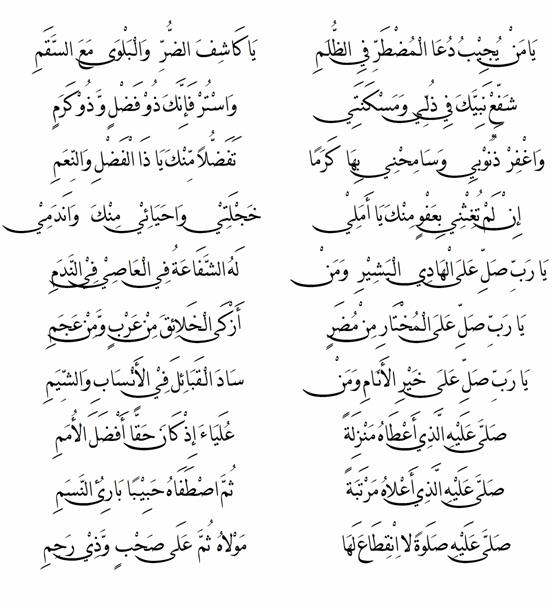
O Ye who accepts the prayers of the distressed in the darkest of
times, Remover of all calamities and illnesses.
Accept the intercession of Your Prophet e on behalf of my weakness and humbleness and conceal my faults,
for indeed You are the bountiful Lord, Most Graceful.
Forgive and pardon my sins out of Your Grace and Your favour, O
Lord of Bounty and favours.
If you do not assist me with your pardon, O my source of hope, how
ashamed I shall feel and how regretful I shall be!
O My Lord, send your blessings upon the Guide, Bearer of
Glad-tidings, he who shall intercede for the sinful and the remorseful.
O My Lord, send blessings upon the chosen one from the tribe of Muḍar,
most pure from amongst all the creation, be they Arab
or non-Arab.
O My Lord, send blessings upon the best of the creation, leader of
all nations in lineage and virtue.
May the being who granted Muḥammad e the highest station send blessings upon him, for he is indeed the
best of all people.
May He who elevated his status send blessings upon him, who the
Creator of all has chosen as His beloved.
May his Lord send infinite blessings upon him, upon his Companions
and his family.
يَا
رَبِّ صَلِّ
وَ سَلِّمْ
دَائِماً
أَبـَدًا عَلَى
حَبِيْبِكَ
خَيـْرِ
الْخَلْقِ
كُلِّهِمِ
44. It is written in Nuzhat
al-Majālis that a person went to visit someone in the final moments
before death. He asked him, “How are you finding the bitterness of death?”
He replied, “I cannot feel anything, because I heard the scholars
say that whoever abundantly confers blessings and salutations upon the Noble Prophet e will be saved from the pangs of death.”
يَا
رَبِّ صَلِّ
وَ سَلِّمْ
دَائِماً
أَبـَدًا عَلَى
حَبِيْبِكَ
خَيـْرِ
الْخَلْقِ
كُلِّهِمِ
45. It
is written in Nuzhat al-Majālis that a
certain saint was suffering from urine retention. He saw the knower of
Allāh (ʿārif billāh) Shaykh Shihābuddīn bin
Raslān (may Allāh have mercy
on him), a great ascetic and scholar, in his dream. He complained about
his illness to the Shaykh. The Shaykh said, “How is it that you are oblivious
to the tried and tested antidote? Recite the following:
اللهُمَّ صَلِّ وَسَلِّمْ وَبَارِكْ عَلَى رُوْحِ سَيِّدِنَا مُحَمَّدٍ فِي الأَرْوَاحِ وَصَلِّ وَسَلِّمْ عَلَى قَلْبِ سَيِّدِنَا مُحَمَّدٍ فِي الْقُلُوْبِ وَصَلِّ وَسَلِّمْ عَلَى جَسَدِ سَيِّدِنَا مُحَمَّدٍ فِي الأَجْسَادِ وَصَلِّ وَسَلِّمْ عَلَى قَبْرِ سَيِّدِنَا مُحَمَّدٍ فِي الْقُبُوْرِ
O Allāh, confer blessings and
salutations upon, and bless the soul of our leader Muḥammad from amongst
all souls. Confer blessings and salutations upon the heart of our leader Muḥammad
amongst all hearts. Confer blessings and salutations upon the body of our
leader Muḥammad amongst all bodies. Confer blessings and salutations upon
the grave of our leader Muḥammad amongst all graves.”
After seeing this dream, he began conferring these blessings in
abundance and thus his illness was cured.
يَا
رَبِّ صَلِّ
وَ سَلِّمْ
دَائِماً
أَبـَدًا عَلَى
حَبِيْبِكَ
خَيـْرِ
الْخَلْقِ
كُلِّهِمِ
46. Ḥāfiẓ Abū Nuʿaym (may
Allāh have mercy on him) relates that Sufyān Thawrī (may Allāh have mercy on him)
said, “I was once leaving my house when my gaze fell upon a youth who was
reading
اللهُمَّ صَلِّ عَلَى مُحَمَّدٍ وَّعَلَى آلِ مُحَمَّدٍ
with every step he took. I
asked him, ‘Is there any proof for your action (or is it just based on your own
opinion)?’
He asked, ‘Who are you?’
I replied, ‘Sufyān Thawrī.’
‘Sufyān of Iraq?’ he asked. I replied in the affirmative.
He asked, ‘Do you have the cognisance (maʿrifa)
of Allāh?’
I replied in the affirmative.
He asked, ‘How did you attain it?’
I said, ‘He takes the night out of the day and the day out of the
night, and He fashions the child in the mother’s womb.’
He said, ‘You have not truly recognized Him.’
I asked him, ‘So how have you come to recognize Him?’
He replied, ‘I firmly decide on doing something, but I end up
having to cancel it. I resolve to do something but find that I am unable to
fulfill it. Through this, I have realised that there is another being who is
governing my affairs.’
I asked him regarding his conferring of blessings. He said, ‘I
went for the Pilgrimage (ḥajj) with my mother. My mother passed
away during the journey. Her face turned black and her stomach bloated whereby I
realised that she had committed a grave sin. As I lifted my hands towards the
sky to beseech Allāh, I saw a cloud coming from Tihāma (Ḥijāz)
from which a man appeared. He passed his hand over my mother’s face making it luminous
and over her stomach, causing the swelling to disappear. I asked him, ‘Who are
you? You have allieviated me and my mother of this great affliction.’
He replied, ‘I am your prophet, Muḥammad e.’ I asked him for some advice. The Prophet e instructed, ‘Whenever you take a step, read
اللهُمَّ صَلِّ عَلَى مُحَمَّدٍ وَّعَلَى آلِ مُحَمَّدٍ
(Nuzhat al-Majālis)
يَا
رَبِّ صَلِّ
وَ سَلِّمْ
دَائِماً
أَبـَدًا عَلَى
حَبِيْبِكَ
خَيـْرِ
الْخَلْقِ
كُلِّهِمِ
47. The author of Iḥyā has
written that after the demise of the Messenger of Allāh e, Sayyidunā ʿUmar was crying and he was
saying, “O Messenger of Allāh, may my parents be sacrificed for your sake.
The trunk of the date tree you would lean upon and deliver the sermon (khuṭba)
before the erection of the pulpit cried after you ascended the pulpit, saddened
by your separation. You passed your hand over it and comforted it (This is a
famous ḥadīth). O Messenger of Allāh, your followers have more
reason to cry over your separation than this date tree (They are more in need
of your attention and comforting upon your separation).
O Messenger of Allāh, may my parents be sacrificed for your
sake. Your status with Allāh is so exalted that your obedience has been declared obedience to Him. Allāh says, “He
who obeys the Messenger has indeed obeyed Allāh.” (al-Nisā
4:80)
O Messenger of Allāh, may my parents be sacrificed for your
sake. You are so great in the eyes of Allāh that your mistakes were excused before you even requested forgiveness. Hence,
Allāh says, “Allāh pardon you! Why did
you give them leave?” (al-Tawbah 11:43)
O Messenger of Allāh, may my parents be sacrificed for your
sake. Your lofty rank with Allāh is such that you have been mentioned
foremost in the covenant taken from the Prophets (blessings and salutations be
upon them), even though you are the last Prophet to be sent. Allāh says, “And
recall when we took a bond from the Prophets and from you, and from Nūḥ
and Ibrāhīm and Mūsā and `Īsā, son of Maryam. And
we took from them a solemn bond.” (al-Aḥzāb 33:7)
O Messenger of Allāh, may my parents be sacrificed for your
sake. You are so great in the eyes of Allāh that the unbelievers in the
Hellfire will be regretful for not obeying you, saying, “Ah! That we had
obeyed Allāh and the Messenger.” (al-Aḥzāb
33:66)
O Messenger of Allāh, may my parents be sacrificed for your
sake. Indeed, Allāh granted Sayyidunā Mūsā u the miracle of making rivers flow from stone but it is no more
extraordinary than Allāh making water gush forth from your fingers.
O Messenger of Allāh, may my parents be sacrificed for your
sake. If the wind was subjected to Sayyidunā Sulaymān u and would transport him in the morning over a distance covered in
one month and likewise in the evening, it is not more amazing than your
surpassing the seven heavens on the Burāq and returning to Makkah
by morning. May Allāh confer blessings upon you.
O Messenger of Allāh, may my parents be sacrificed for your
sake. If Sayyidunā ʿĪsā u was granted the miracle of bringing the
dead back to life, it is not more amazing than a goat cut into many pieces and
roasted, speaking to you and telling you not to eat it because it has been
poisoned.
O Messenger of Allāh, may my parents be sacrificed for your
sake. Sayyidunā Nūḥ u supplicated against
his people, “My Lord! Leave not of the infidels any inhabitant upon the
earth.” (Nūḥ 71:26)
Had you supplicated against us, nobody from amongst us would have
survived. The unbelievers placed the intestines of a camel on your back whilst
you were in prostration. In the Battle of Uḥud, they caused your face to be covered in blood and broke your tooth. Despite this, you
did not curse them. Instead, you supplicated, “O Allāh, forgive my people
for they know not.”
O Messenger of Allāh, may my parents be sacrificed for your
sake. Within a short period of your life (twenty three
years as a prophet), more people accepted Islām than those who accepted during
the lengthy lifetime (approximately one thousand years) of Sayyidunā
Nūḥ u (At the time of the
Farewell Pilgrimage (ḥajja al-widāʿ), one hundred and
twenty four thousand Companions y were present.
Only Allāh knows how many had entered the fold of Islām and were unable to attend).
The number of people who brought faith upon you is great (In the ḥadīth
narrated by Bukhārī in his Saḥīḥ, the Noble
Prophet e says that he saw his
followers in such a great number that they had covered the horizon). Very few
people brought faith upon Sayyidunā Nuh u. Allāh says in the Qur’ān, “And these had not
believed with him save a few.” (Hūd 11:40)
O Messenger of Allāh, may my parents be sacrificed for your
sake. If you were only to entertain and meet those of the same standing as you,
you would never have sat with us. If you were not to marry except a woman of
the same status as yourself, never would you have married any of our women. If
you were to feed only those who were as exalted as you,
never would you have fed anyone amongst us. Indeed, you sat with us, married
our women, allowed us sit and eat with you, wore clothes made of hair, mounted
a donkey and sat on the floor and ate. You would lick your fingers after eating
and all this was out of humility. Allāh confer
blessings upon you.
يَا
رَبِّ صَلِّ
وَ سَلِّمْ
دَائِماً
أَبـَدًا عَلَى
حَبِيْبِكَ
خَيـْرِ
الْخَلْقِ
كُلِّهِمِ
48. It is narrated in Nuzhat
al-Basātīn that Ibrāhīm Khawwāṣ (may Allāh have mercy on him)
said, “I experienced extreme thirst once whilst travelling, so much so that I
fell unconscious. Someone sprinkled water on my face. I woke up to see a most handsome man on
horseback. He gave me some water to drink and told me to stay with him. A short
while passed before he asked me, ‘Look, what do you see?’
I replied, ‘This is Madīna.’
He said, ‘Dismount. Convey my salutations to the Messenger of
Allāh e and inform him that his
brother Khiḍr u conveyed salutations.’”
Shaykh Abūl Khayr Aqṭaʿ (may Allāh have mercy on him)
says, “I went to Madīna Munawwara. I stayed there for five days but did
not experience any enjoyment or pleasure. I went to the blessed grave and
conferred salutations to the
Noble Prophet e,
Sayyidunā Abū Bakr and Sayyidunā ʿUmar y and then said, ‘O Messenger of Allāh, I am your guest.’
Thereafter, I went to sleep behind the pulpit. In my dream, I saw the Noble
Messenger e. Sayyidunā
Abū Bakr t was standing
to his right and Sayyidunā ʿAlī
t was standing at the front.
Sayyidunā ʿAlī t nudged me saying, ‘Stand up. The Messenger of Allāh e is coming.’ I stood and kissed the Noble Prophet e on his forehead. The Noble Prophet e granted me a piece of bread. I ate one half in my dream and found
the other half in my hand when I woke up.”
This story of Abūl Khayr (may Allāh have mercy on him) has also been narrated in Al-Qawl
al-Badīʿ. However, the wording of Al-Qawl al-Badīʿ
shows that there is a mistake in the translation of Nuzhat al-Majālis.
The wording of Al-Qawl al-Badīʿ is aqamtu khamsata
ayyāmin mā dhuqtu dhawāqan (I stayed in Madīna for five
days and did not taste anything). To translate this as not experiencing any
pleasure or enjoyment is inaccurate.
This story has previously been narrated in the Virtues of Ḥajj under the eighth story and a similar
story has been narrated by Ibn Jalā on the authority of Wafā
al-Wafā under the twenty-third story. Numerous similar
incidents were experienced by the pious elders as narrated in Wafā
al-Wafā.
The Shaykh of all shaykhs Leader of the Believers in the science
of ḥadīth (Amīr al-muʿminīn fī
al-ḥadīth) Shāh Waliyullāh (may Allāh have mercy on him) wrote Al-Ḥirz al-Thamīn fī mubashirāt al-Nabiyy al-Amīn,
a short treatise in which he has recorded forty dreams or manifestations in wherein
he or his father saw the Noble Prophet e.
He writes, “I was once extremely hungry (only Allāh knows how
many days passed in this state). I implored Allāh and thus saw that the
blessed soul of the Noble Prophet e has come down
from the heavens and he was carrying a piece of bread. It seemed that
Allāh had instructed the Noble Prophet e to give me this bread.” (Number twelve)
He further writes, “I did not have anything to eat to eat one
night. A friend of mine gave me a glass of milk, which I drank and then went to
sleep. I saw the Noble Prophet e in my dream.
He said, ‘I was the one who sent you this milk (I directed my attention towards
your friend and as a result, it came into his heart that he should give you
this glass of milk).’”
When the effect of the spiritual attention of the saints is
accepted and well known, what question could arise in respect to the power of
the Noble Prophet’s e spiritual attention?
Shāh Waliyullāh (may
Allāh have mercy on him) writes under number fifteen, “My father told
me that he once became ill and in this illness, he was blessed with seeing the
Noble Prophet e in his dream. The Noble
Prophet e asked, ‘How are you
feeling, my son?’ Thereafter, the Noble Prophet e ensured him that he will recover and granted him two hairs from
his blessed beard. When my father woke up, he found both hairs in his hand and
he granted me one of these hairs.”
Shāh Waliyullāh (may
Allāh have mercy on him) writes under number eighteen that his
father told him, “When I was in the early days of my education, I considered
fasting everyday but was uncertain due to the differing opinions of scholars
regarding its permissibility . I saw the Noble Prophet e in my dream. He granted me a piece of bread. Sayyidunā
Abū Bakr t, Sayyidunā ʿUmar t and other
Companions y were also present.
Sayyidunā Abū Bakr t said to me, ‘Al-hadāyā
mushtaraka (Gifts are to be shared).’ I thus placed the bread infront of
him and he tore some off. Sayyidunā ʿUmar t said the same. I placed the
bread before him too, and he tore a portion off. When
Sayyidunā ʿUthmān t said
the same thing, I replied, ‘If this continues on the basis of Al-hadāyā
mushtaraka, this piece of bread will finish in this manner. What
will this destitute one be left with?’”
In Al-Ḥirz al-Thāmīn, this
story is as above. In another book of Shāh Waliyullāh (may Allāh have mercy on him), Anfās
al-ʿĀrifīn, more
detail has been mentioned. His father said, “When I woke up, I pondered as to
why I presented the bread to the Shaykhayn y upon their request but did not do the same for Sayyidunā ʿUthmān t. I concluded that my Naqshbandiyya connection meets
Sayyidunā Abū Bakr t and I am a
descendant of Sayyidunā ʿUmar t, so I was unable to refuse them. As for Sayyidunā ʿUthman t, I am neither
related to him in taṣawwuf nor in lineage, and thus I plucked up enough
courage to speak up.”
The authenticity of the ḥadīth ‘Al-hadāyā
mushtaraka’ has been criticised by the ḥadīth scholars. I have
mentioned two stories regarding this at the end of the Virtues of Ḥajj; one story is regarding a pious elder and the other regarding
the Jurist of the Umma (Faqīh al-umma) Imām Abū
Yūsuf (may Allāh have mercy
on him). A discussion on this ḥadīth is not the purpose at
this point. The point to be clarified is how
materialistic blessings are also showered upon the followers of the most
generous from amongst humankind, the Leader of both worlds, Muḥammad e.
Shāh Waliyullāh (may
Allāh have mercy on him) writes in Al-Ḥirz
al-Thāmīn under number nineteen that his father related, “I was
travelling in the blessed month of Ramaḍan. It was extremely hot and I
was undergoing great difficulty. I fell asleep and saw the Noble Prophet e. The Noble Prophet granted me a most delicious sweet dish
containing rice, saffron, sugar and ghee. I ate to my fill. Thereafter, the
Noble Prophet e gave me some water. My
thirst and hunger were totally quenched and when I woke up, I could smell the
fragrance of saffron on my fingers.”
One should not question such stories, for the basis of these
stories is present in the ḥadīths of continuous fasting in
which the Noble Prophet e said, “My
Lord feeds me and gives me to drink.”
As for the Noble Prophet’s e saying, “I am not the same as you”, this will be in reference to
the common people. Otherwise, if someone is fortunate to be given
this as a miracle, there is no reason to object. It is the creed of the Ahl
al- Sunna wa ’-l Jamāʿa that the miracles of the friends of
Allāh are true.
The Qur’ān relates the story of Maryam as follows:
كُلَّمَا دَخَلَ عَلَيْهَا زَكَرِيَّا الْمِحْرَابَ وَجَدَ عِنْدَهَا رِزْقًا
Whenever Zakariyya entered the apartment to see her, he found
provision by her. He said, “O Maryam! Whence have you this?” She said, “This is
from Allāh.” Surely, Allāh provides for whom He wills without
stint. (Āl ʿImrān 3:37)
In the narrations of Al-Durr al-Manthūr, this
sustenance is said to be baskets filled with grapes
out of season. In the winter, one would find fruits only available in summer
months and vice versa.
يَا
رَبِّ صَلِّ
وَ سَلِّمْ
دَائِماً
أَبـَدًا عَلَى
حَبِيْبِكَ
خَيـْرِ
الْخَلْقِ
كُلِّهِمِ
49. In
Nuzhat al-Majālis, an amazing story has been
narrated regarding a debate that took place between Night and Day, each
one of them trying to prove its virtue over the other.
Day said to Night, “I am greater than you. Three obligatory
prayers take place performed in me whilst only two take place in you. I contain
the moment of acceptance on the Friday wherein no person asks Allāh for
anything except that it is granted (as mentioned in an
authentic ḥadīth). The fasts of Ramaḍan are observed
in me too. You are just a time for sleep and wherein people are absentminded. I
am accompanied by wakefulness and being active, and there are great blessings
in being active. The sun also rises in me and brings light to the whole world.”
Night replied by saying, “If you pride yourself over the sun, then
I consider the hearts of those who stand in prayer at night and the hearts of
those who ponder over the wisdom behind Allāh’s creation much greater than
the sun. How can you ever reach the pinnacle of ecstasy the lovers experience
when they are in solitude with me? How can you compare yourself to the Night of
Ascension? What reply do you have to Allāh’s order to His Messenger e, when He the Almighty said, ‘And of the night keep the vigil
therein as an act of supererogation for you.’ (al-Isrā 17:79)
Allāh created me before you. I contain the Night of Decree in
which the Sovereign bestows countless favours. Allāh calls out in the
latter portion of the night, ‘Is there anyone who asks of me that I may bestow
upon him? Is there anyone seeking forgiveness so that I may forgive him?’ Are
you not aware that Allāh has said ‘O you enwrapped! Keep vigil all
night save a little?’ (al-Muzammil 73: 1-2)
Have you not heard Allāh say, ‘Hallowed be He who took for
a journey His bondsman in a night from the Sacred Mosque to the Farthest Mosque.’? (al-Isrā 17:1)”
Indeed, the Miʿrāj
holds a distinguished and focal point in the miracles of the Noble Prophet e. Qād}ī ʿIyād} (may Allāh have mercy on him)
writes in Al-Shifā that the miracle of the Miʿrāj
is one of the great virtues of the Noble Prophet e and holds numerous points of virtue; conversing with the
Almighty, seeing Allāh, leading all the Prophets in prayer and visiting
the Lote Tree of the Utmost Boundary. “Assuredly, he beheld of the greatest
signs of his Lord.” (al-Najm 53:18)
The story of Miʿrāj
and the lofty stations mentioned in the Qur’ān and authentic ḥadīths
regarding this incident are all from amongst the virtues specific to the Noble
Prophet e.
This story has been briefly
narrated in the Qaṣīda Burdah (poem of the scarf) and Shaykh Thānawī
(may Allāh have mercy on him)
has noted this with its translation in Nashr al-Ṭīb. We
present this story here:
سَرَيْتَ مِنْ حَرَمٍ لَيْلاً إِلَى حَرَمِ
كَمَا سَرَى الْبَدْرُ فِيْ دَاجٍ مِّنَ الظُّلَمِ
You travelled by night from the
Masjid Harām to the Masjid Aqṣā (despite the fact
that the distance between the two normally takes forty days to travel) just as
the full moon pierces the veil of darkness at night with its light.
وَبِتَّ تَرْقَى إِلَى أَنْ نِلْتَ مَنْزِلَةً
مِنْ قَابَ قَوْسَيْنِ لَمْ تُدْرَكْ وَلَمْ تُرَمِ
You spent the night continually
ascending until you reached such proximity to the Almighty that none of His
chosen servants have ever attained. So lofty was this
station that nobody has ever sought to reach it.
وَقَدَّمَتْكَ جَمِيْعُ الأَنِبِيَاءِ بِهَا
والرُّسْلِ تَقْدِيْمَ مَخْدُوْمٍ عَلَى خَدَمِ
All the Noble Prophets
appointed you as their leader and guide at the Masjid Aqṣā,
in the same manner the master is preferred over his attendants.
وَأَنْتَ تَخْتَرِقُ السَّبْعَ الطِّبَاقَ بِهِمْ
فِيْ مَوْكَبٍ أَنْتَ فِيْهِ صَاحِبُ الْعَلَمِ
You surpassed the seven
heavens, one above the other, accompanied by a large group of angels (out of
your great honour and esteem), you being the leader and standard
bearer amongst them.
حَتَّى إِذَا لَمْ تَدَعْ شَأْوًا لِمُسْتَبِقٍ
مِنَ الدُّنُوِّ وَلاَ مَرْقًا لِمُسْتَنِمِ
You continued
ascending towards your lofty rank, passing through the heavens until you
reached the pinnacle of proximity, beyond which nobody seeking closeness can
strive for, nor can anyone wishing to advance exceed.
خَفَضْتَ كُلَّ مَكَانٍ بِالإِضَافَةِ إِذْ
نُوْدِيْتَ بِالرَّفْعِ مِثْلَ الْمُفْرَدِ الْعَلَمِ
You made the station of
everyone inferior in comparison to the status bestowed upon you by the Almighty
(when your ascension reached its utmost limit) and when He said to you, “Come
close,”
كَيْمَا تَفُوْزُ بِوَصْلٍ أَيَّ مُسْتَتَرٍ
عَنِ الْعُيُوْنِ وَسِرٍّ أَيَّ مُكْتَتَمِ
This was so that you succeed in
your meeting with Him, totally hidden from any of His creation, and that you
are successful in the secret concealed from all.
Mawlānā Thānawī
(may Allāh have mercy on him)
has taken the story of Miʿrāj from the Qaṣīda
Burdah and the Urdu translation was taken from ʿIṭr al-Wardah,
written by Mawlānā Zulfaqār ʿAlī, father of
Shaykhul Hind Mawlānā Maḥmudul Ḥasan Deobandī (raḥimahumallāh).
Thereafter, the honourable Shaykh wrote the last verse and followed it with his
own verse:
ولنختم
الكلام على
وقعة الإسراء بالصلوة
على سيد أهل
اصطفاء
وآله
وأصحابه أهل
الإجتباء ما دامت
الأرض
والسماء
We finish our discussion with
the story of Isrā, by conferring ṣalāt upon the Leader of all
the chosen ones,
And upon his family, his
Companions y who
were selected for his company, for as long as the heavens and earth exist.
يَا
رَبِّ صَلِّ
وَ سَلِّمْ
دَائِماً
أَبـَدًا عَلَى
حَبِيْبِكَ
خَيـْرِ
الْخَلْقِ
كُلِّهِمِ
50. Whilst writing
these series of books regarding the virtues of certain deeds, this humble
servant as well as others saw many glad-tidings and good dreams. Whilst in the
process of writing this book, I once saw in a dream that I was
being ordered to write a poem in this book. The poem was
not specified. However, whilst this humble servant was awake between the
two dreams (I saw this dream twice) or in my dream, it crossed my mind that the
famous qaṣīda of Mawlānā Jāmī (may Allāh have mercy on him) was
being referred to, which is in the beginning of Yūsuf Zulaykhā.
I was around ten or eleven
years of age when I studied this book by my father in Gangoh. At that time, I
heard my father relate a story regarding the qaṣīda and it
was this story which led my attention to be drawn
towards this qaṣīda in my dream.
The story was that
Mawlānā Jāmī (may
Allāh have mercy on him) went for the Ḥajj pilgrimage after
composing this poem and intended to stand at the blessed grave and recite this
poem. Upon completing the Ḥajj and before heading towards Madīna,
the Governor of Makkah saw the Noble Prophet e in his dream. The Noble
Prophet e
told him in his dream, “Do not let him go to Madīna.” The Governor of
Makkah stopped him from proceeding to Madīna. However, his intense love
and yearning for the Noble Prophet e was so intense that he secretly left for Madīna.
The Governor of Makkah saw the
same dream. The Noble Prophet e said, “He is heading towards Madīna.
Do not let him come.” The Governor of Makkah sent two men in his pursuit and he
punished and imprisoned him.
The Governor saw the Noble
Prophet e for
a third time in his dream. The Noble Prophet e said to him, “He is not a criminal
that he should be imprisoned. He has composed a few verses of poetry which he intends to read at my grave. If he does so,
my hand will come out of my grave to shake his hand and this will become a
means of people falling into tribulation.” Thus, he was
released from prison and treated with great respect and dignity.
I have no doubt as to having
heard this story and I clearly remember its details. However, due to weak
eyesight and illness, I am unable to search the books for its source of origin.
If any of the readers find it in any book in the lifetime of this humble
servant, I will be most grateful if you would inform me. If it is after my
demise, then it should be added to the footnotes. It
was due to this very story that my mind went towards this qaṣīda
and it has been in my mind since, and there is nothing far-fetched about this.
Sayyid Aḥmad Rifāʿī
(may Allāh have mercy on him)
is amongst the famous saints of the ṣūfiyā and his story
is famous. In 555 AH, he presented himself at the blessed grave of the Noble
Prophet e and
as he neared the grave, recited two verses of poetry. The blessed hand of the
Noble Prophet e
came out of the grave and Sayyid Aḥmad Rifāʿī (may Allāh have mercy on him)
kissed it.
The Virtues of Ḥajj, compiled by this humble servant, contains this story
under the chapter of visiting Madīna under story number twelve. It has
been discussed in detail on the authority of ʿAllāma Suyūṭī’s
(may Allāh have mercy on him)
book, Al-Ḥāwī. Many other stories
in the Virtues of Ḥajj narrate how people received a
reply to their salutations at the blessed grave.
Some of my friends think that
my dream is referring to the Qaṣīda Burdah, which is why I
firstly presented a few verses from the Qaṣīda regarding the Miʿrāj.
Others think it is referring to one of the poems of Ḥujjat al-Islām
Mawlānā Qāsim Nānawtwī (may Allāh have mercy on him). Hence, I thought it
appropriate to relate a few verses from the Qaṣā’id Qāsmiyya
and conclude the book.
The qaṣīda of
Mawlānā Jāmī (may
Allāh have mercy on him) is in Persian and the principal of our madrasah
Mawlānā Al-Ḥāj Asʿadullāh (may Allāh have mercy on him) is
proficient in Persian, alongside his interest in poetry. He is also one of the
prominent disciples of Shaykh Thānawī (may Allāh have mercy on him), making his love for the Noble
Prophet e
even more intense. For this reason, I requested the respected Mawlānā
to translate these verses in the most befitting manner. He accepted the
request. After these verses, the translation will be presented, followed by the
Qaṣā’id Qāsmiyyah.
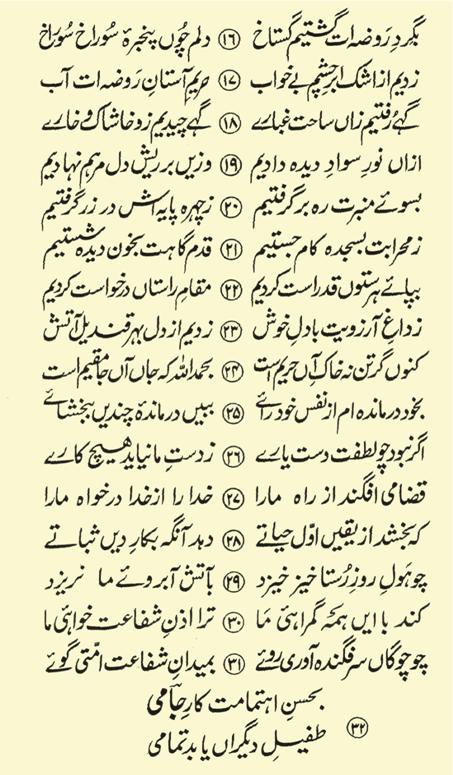
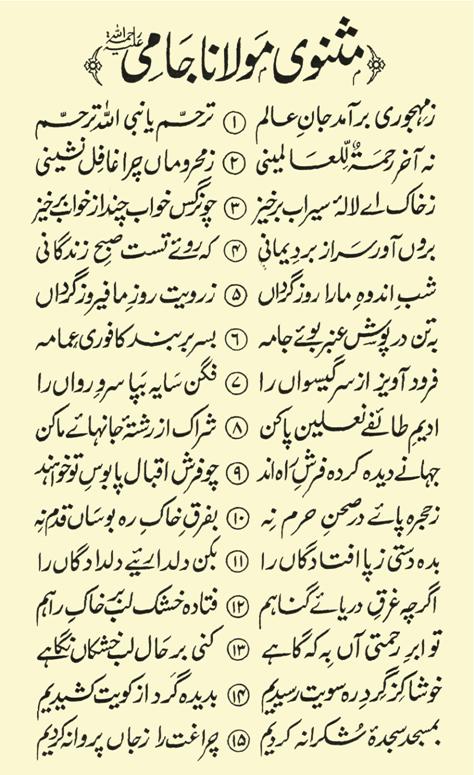
Every particle of the universe is bereaved upon your parting. Bestow us with your look of
favour, O Messenger of Allah. Be merciful, O Seal of all messengers.
Indeed, you are a mercy to the
worlds, so how can you neglect us misfortunate ones who are suffering from ill-fate?
O beautiful flower, grace the
world with your vibrant fragrance and awake from your restful sleep to
illuminate the hearts of those in need of guidance.
O ye who
rests in his grave in Madina. Awake, for the whole Earth has become
corrupt.)
Show us your blessed
countenance from within your Yemeni shroud; your luminous face is the dawn of
all life.
Bring daylight upon our long
nights of grief, and make our days blossom with
success and prosperity with your beauty.
Adorn your body with your
fragrant amber-emanating garments, and crown your head with the turban,
fragrant with the scent of camphor.
Let your fragrant locks of hair
flow, shedding shade upon your blessed feet (an indication towards the fact
that the Noble Prophet e did not have a shadow).
Wear the sandals of Ṭā’if
as you once did wear and let their laces be made of our deep heartfelt
conviction for you.
Each and everything has spread
itself out before you, eagerly awaiting to kiss your
blessed feet.
Come forth from your blessed
chamber into the courtyard of the ḥaram. Place your feet on the
heads of those who lie in your path, desirous of kissing the dust you tread on.
Take the helpless by the hand
and assist them. Console the hearts of your sincere lovers.
Indeed, we are drowning in our
ocean of our sins, but we wait on your path for our thirst to be quenched.
Verily, you are the cloud,
which rains with mercy and it befits your compassion that you shower the
thirsty with your generosity.
(Before proceeding with the
translation of the remaining verses, it is important to note that most people
are of the opinion that Mawlānā Jāmī (may Allāh have mercy on him) is
describing a previous visit. Others are of the opinion that he is imagining a
visit in the future. The honourable Shaykhul Ḥadīth is of the latter
opinion and thus, this has been borne in mind in the translation.)
How wonderful will it be when
we arrive in your presence and apply the dust of your blessed city in our eyes!
(May Allah grant us that day
when we shall go to Madinah, and make collyrium out of the dust of the
Prophet’s e city)
And how beautiful will that time
be when after performing two rakʿāt in
gratitude and prostrating thankfully, my grievous soul circles the blazing lamp
of your blessed chamber like a butterfly!
Overwhelmed with love and
restless for your communion, I shall walk to and fro
to your blessed chamber, your burning love tearing my heart into pieces.
How glorious that day will be
when the clouds of my sleepless eyes shall rain with tears and I shall sprinkle
those tears over the threshold of your Ḥaram
and your blessed grave!
At times, I shall gain the
honour of sweeping the dust of the ḥaram and to
remove the dust and litter from your blessed mosque.
Dust maybe harmful for our
eyes, we know, yet the dust of your city is a light for our eyes. Although our wounds will be harmed by litter, it is the only cure for
the wounds of our distressed hearts.
We would proceed towards your
blessed pulpit thereupon rub our faces pale out of longing for you, painting
our faces with its dust.
In your exalted miḥrāb
and where you did perform ṣalāh would we stand in prayer, fulfilling
the desires of our hearts and succeeding in all our goals.
The place where your blessed feet stood would I bath
with tears of blood, shed in yearning for you.
We would stand with humility
before every pillar of your mosque, beseeching Allāh to elevate us to the
ranks of the righteous.
Out of extreme pleasure, the
great desires and yearning in our hearts will brightly light every candle on
earth.
I may not be physically present
in your sacred ḥaram, but all gratitude to Allāh, that my
soul is most certainly there.
Perturbed I am over the state
of my selfish desires, so assist this helpless one in his despondency and turn
towards him your benevolent gaze.
If your loving generosity does
not come to our aid, we will remain no more than a paralysed limb, unable to
continue our lives.
Our wretchedness is diverting
us from the straight path, the way of Allāh. We earnestly plead you to
supplicate on our behalf.
Pray that the Almighty makes
our lives successful through strong faith and conviction, and that we always
remain firm in implementing His divine commands.
And when the Day of Judgement
arrives with its horrific terrors, the Owner of the Day of Retribution, the
Most Merciful protects us from the Hellfire, saving us from disgrace.
Despite all our sins and
wrongdoings, He should grant you permission to intercede on our behalf, for
none can intercede except with His permission.
And pray that your head does not
lower in shame due to our crimes, but that you arrive saying, “O my Lord, show
mercy on my followers.”
Through your relentless effort
and the intermediary of the chosen bondsmen of Allāh is the needy
Jāmī hopeful of salvation.
(I have heard that on the Day
of Judgement, Allah will forgive the sinners through the intercession of the
righteous.)
All praise is due to Allah.
Through the blessing of Haḍrat Shaykh, this defective translation has been completed on the morning of 26 Zil Qaʿdah
1384 AH.
(Haḍrat Mawlānā
Asʿadullāh
Sahib)
From the Qaṣā’id
Qāsmiyyah of Ḥujjat al-Islām Mawlānā Qāsim
Nānawtwī (may Allāh
have mercy on him) the founder of Darul Uloom Deoband, I present before
you a few verses of the famous Qaṣā’id Bihāriyah.
It consists of over one hundred and fifty verses and to write all of them is
difficult. If you wish to read all of them, refer to the original book. I am
relating just over sixty couplets, which clearly display Mawlānā Qāsim
Nānawtwī’s (may Allāh
have mercy on him) profound and ecstatic love for the Noble Prophet e.
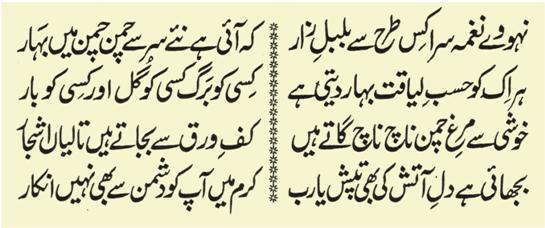
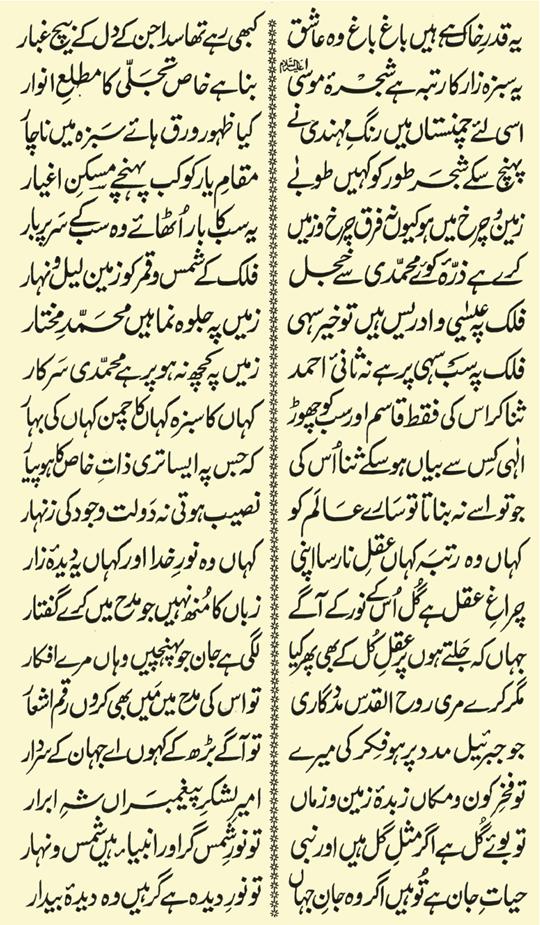
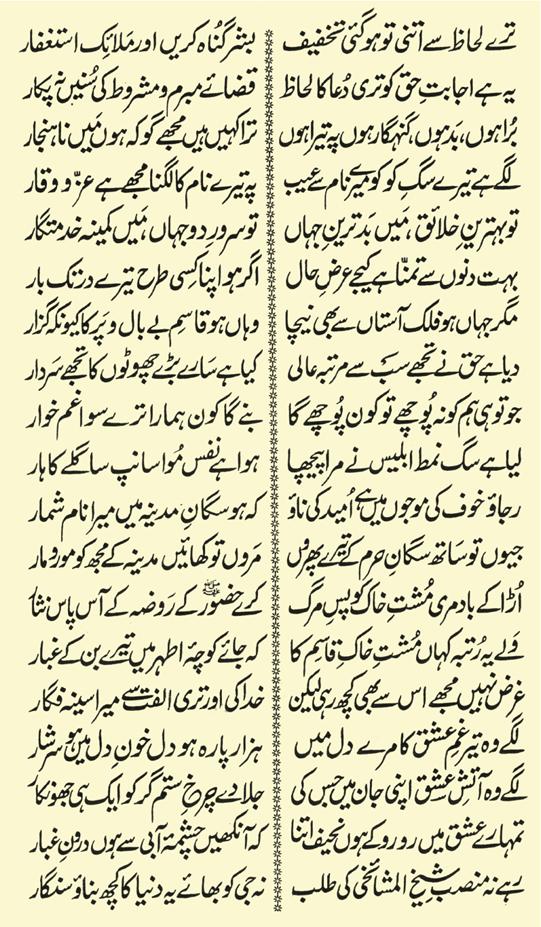
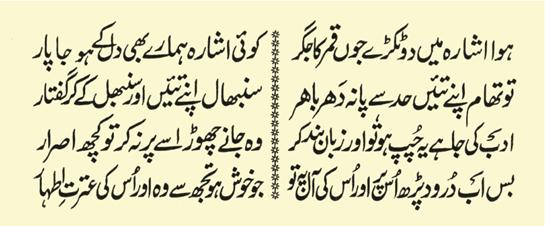
Why
should the nightingale of the garden not sing,
When every garden blossoms with spring?
It
gives everything its due share;
To
some a leaf, to some a flower and to others it bears fruit.
In
happiness do the birds dance and sing.
The
trees are applauding with their leaves.
You
have put out the blazing heat of the fire, O Lord!
Your
benevolence you do not even deny your enemy.
This
is nothing, for the true joy is that of the lovers now rejoicing,
Whose
hearts were once always filled with the pain of
separation!
This
is the status of the meadow, the tree of Mūsā u,
Where
the light of Your splendour shines with brilliance.
Thus,
the colour of henna is evident in the garden,
Even though the leaves are green.
Can
Ṭūbā (tree of
Can
the abode of a stranger ever equal the abode of the
beloved?
Why
should there not be a difference between the earth and the sky,
When
the earth bears the weight of everything and the sky is a weight upon everyone?
Indeed,
a mere particle of dust from the path of Muḥammad e has belittled
The sun and stars of the sky, putting the night and day to
shame.
Indeed,
‘Īsā u and Idrīs u are present in the heavens.
But the majesty of Muḥammad e the Chosen One does shine upon the Earth.
The
heavens may contain everything, but none can compare to Aḥmad
.
The
Earth may have nothing, but our Muḥammad e is present therein.
O
Qāsim, praise him alone and leave the praise of all others.
Why
look towards the greenery, the garden and the spring?
O
Lord, Who can possibly praise him adequately,
He
who is showered with your special affection?
Had
you not created him,
Never
would this universe have been brought into existence.
How
can our limited minds possibly comprehend his status?
How
is it possible for our eyes to truly perceive the
light from Allāh?
The
light of our intellect is extinguished before the
light of his splendour.
Our
tongues are unable to duly express words in his
praise.
If
even the wings of Jibrīl u begin to burn
at such heights,
How
possibly can my thoughts reach such loftiness?
But
if the Holy Spirit u assists me,
I
shall also pen down a few couplets in his praise.
If
Jibrīl u comes to my aid, I shall
step forward,
Saying “O Leader of the Universe!”
You
are the Pride of everything, the Essence of this world and for all time,
Leader of the Caravan of Messengers, King of the Righteous.
You
are the scent of the flower, if all other Prophets are
likened to flowers.
If
they are compared to the sun, indeed you are then the
very light of the sun.
The
very spirit of life you are, if they are the life of all the creation.
Indeed,
you are the pupil if they are likened to the eye.
Through
your blessing was the universe created.
Wrong
we are not in calling you the beginning of all life.
Everything
was granted life from non-existence due to you.
Indeed
your rank and spiritual progress were unparalleled.
All
perfection has been placed in your being.
Your
noble qualities are but a few in others.
No
prophet has ever reached your status.
Even
the great Prophets who worked miracles were unable to achieve your rank.
O
Prophet of Allāh, all the Prophets take pride in calling themselves your
follower.
The
Hand of the Lord would not have touched the form of Adam
If
your coming was not destined at the end.
Sayyidunā
Mūsā requested the vision of Allāh
But Allāh Himself called you to His presence.
Can
the pinnacle of Ṭūr possibly compare with the heights of your
Nightly Ascension?
Has
the Earth ever been comparable with the heavens?
How
can the beauty of Yūsuf u reach your
beauty?
Zulaykhā was entranced by his beauty whilst
Allāh Himself called you to His presence.
Your
true beauty was concealed in your human form.
Allāh
alone knows your reality.
No
angel or prophet could possibly infringe your seclusion with Allāh, nor
would Allāh allow it. Indeed, you are his beloved and others are
outsiders.
The
moon never attained your beauty even for one night,
Even though it makes it appearance on countless occasions.
But how can I ever deserve this good fortune,
For I am sinful as much as you are most perfect.
But
even my sins though they may be great in number,
Cannot reach the number of your perfect qualities, O Leader
of Both Worlds, King of the Righteous.
It
is not inconceivable that due to your proximity to Allāh,
The
sins of your followers will be counted as virtues on
the Day of Judgement.
The
wrongdoings of your followers will be such
That
forgiveness unlimited shall rain upon even the smallest of sins.
Relying
upon you do I tread the path of obedience,
For
the sins of Qāsim are most heinous, and he is surely one of evil ways.
If
sins are apprehensive of the wrath of the Almighty,
Then
upon your intercession are the lovers hopeful of pardon.
I
have committed sins greater than mountains,
But I have heard you will intercede for the sinners.
So
greatly esteemed you are by the Almighty,
That
whilst mankind commit sins, the angels seek
forgiveness on their behalf.
Allāh
holds your supplication in such esteem,
That
for your prayers does He change the affairs decreed by fate.
Sinful
and bad though I am, I am still yours.
Yes,
I am insignificant, but despite this, I am still your servant.
Indeed it is an insult that my name be attached to the
dogs of your city,
But honour for me lies in my being attributed to
your noble being.
You
are the best of all the creation, and indeed I am the
worst.
Whilst
you are the leader of both worlds, I am nothing but a worthless servant.
For
many days have I yearned to express my feelings to you,
If I could possibly find a way to your blessed presence.
But where the sky is even lower than the doorstep
How
can the destitute Qāsim even pass by there?
Allāh
has bestowed you with the most exalted status.
Leader
of all has He crowned you.
Who
is there to care for us if even you do not give us your attention?
Who
else can we turn to, to listen to our grief?
The
dog of Satan pursues me,
My
lowly desires hang around my neck like a snake.
Amidst
the waves of hope and fear do I cling to the ship of hope,
That
I also be considered amongst the dogs of Madīna.
I
pray my life passes with the dogs of Madīna,
And that the insects of your blessed city decompose
my body after I die.
May
the wind blow my ashes after I die,
And scatter them around the Blessed Grave of the
Prophet e.
But how can even the remains of Qāsim attain
this rank,
That
they reach your holy city even in the form of dust?
No
hope does there remain for this either,
I
solely desire that my heart burns with the love of
Allāh and in your love.
May
the arrow of your love pierce my heart,
Shedding it into countless pieces, filling my blood with the intoxication
of your desire.
May
such a burning fire of your love strike my soul,
That
were its one spark to touch the sky, it would turn it to ashes.
May
I cry profusely in yearning for you, making me weak.
Let
my eyes shed fountains of tears until my eyes remain no more.
Let
not the desire of being the greatest of all shaykhs remain,
Nor should my heart long for the adornment of this life.
The
moon was split into two by the gesture of your finger.
May
my heart also be cleft asunder in such a way.
Stay
within your bounds and compose yourself.
Control
yourself and think carefully before you speak.
This is the
place where utmost respect is to be upheld, so remain
quiet. Leave it to him and don’t persist in your
request.
Leave
everything else and just conferṣalātupon him and his family,
Pleasing him thereby and his pure household.
My Lord,
confer upon him and all his family
Blessings
that cannot be counted.
As mentioned
in the beginning, I began writing this book on 25th Ramaḍān.
Due to my commitments during the holy month, I was unable to pen down more than
the first few lines. Even after this, I had very little time to write due to
the great number of guests and the commitments of the new madrasah term.
Despite this, the work carried on slowly.
When the
leader of the tablīghī jamāʿat Al-Ḥāj
Mawlānā Muḥammad Yūsuf Kandahlawī (may Allāh have mercy on him)
passed away last Friday, it crossed my mind that if this humble servant was
also to pass away suddenly, the few pages I have written until now will remain
unfinished and go to waste. Thus, I have decided to suffice upon whatever
little I have written and I finish this book on the morning of Friday 6th
Zil Ḥijjah 1384 AH. May Allāh forgive any shortcomings therein
through His infinite grace and through the intermediary of His Prophet e.
Muḥammad
Zakariyyā Kandhalawī
Madrasah
Mazāhire ʿUlūm
Fazaaile-Durood: Contents Page